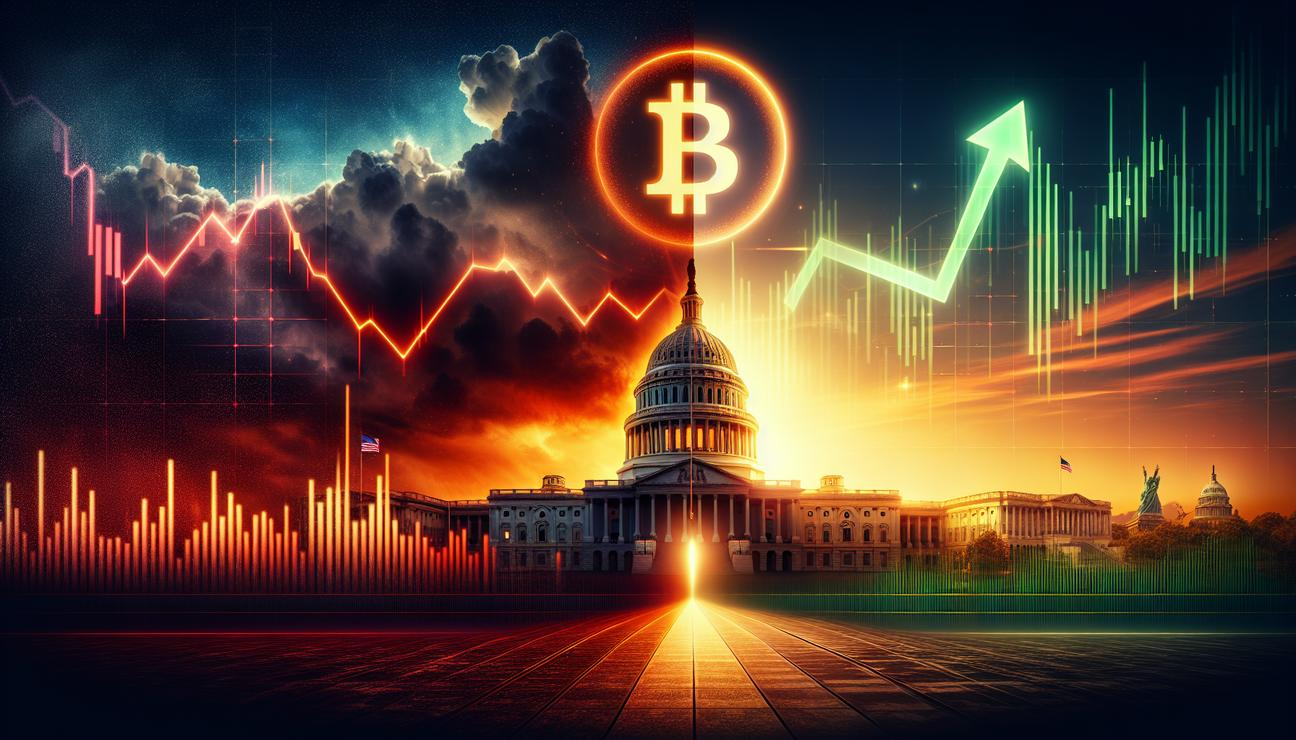
Bitcoin (BTC) slipped to around $72,800 yesterday as U.S. lawmakers debated a stopgap funding package. The move came just before the House passed the bill on February 4, 2026, which eased fears of a government shutdown. After the vote, Bitcoin quickly rebounded and rose more than 5% in a few hours. The quick recovery showed how closely crypto prices still follow U.S. political risk, even when there is no new news about blockchain technology itself.
Shutdown Fears Ripple Through Crypto
Analysts at the on-chain analytics firm Santiment noted that the sell-off happened during U.S. trading hours. Headlines focused on a tight vote in the House. As uncertainty built, BTC fell. This decline also coincided with about $30 million in liquidations in decentralized finance (DeFi). A liquidations event happens when traders are forced to close out positions because the market price moves against them. The drop in Bitcoin also lined up with falls in two other major markets: the S&P 500, which tracks large U.S. companies, and gold, a traditional safe-haven asset. This shows traders were pulling back from many volatile assets, not just Bitcoin, because of the political standoff.
The main worry was whether Congress would approve a roughly $1.2 trillion funding package. If approved, the money would keep most federal agencies running through September 30. If not, the government could partially shut down. A shutdown would delay the release of important economic data and add stress to an already cautious market environment.
The vote itself showed some Republican divisions. One representative voted against the bill because of provisions about foreign aid. Despite this, the bill passed, avoiding a shutdown and providing immediate relief to markets. Bitcoin bounced from its low point and climbed over 5% within hours. The S&P 500 also recovered. Santiment said the fast rebound suggested the earlier sell-off was driven by fears about political dysfunction, not a fundamental change in Bitcoin’s value. In other words, traders did not suddenly think Bitcoin was worth less; they were worried about the political process in Washington.
Broader Pressures on Bitcoin’s Price
Even with the short-term relief from the funding bill, Bitcoin faces longer-term challenges. Data from CoinGecko shows the asset is down about 14% in the last seven days and down about 17% for the month. This means Bitcoin has lost more value recently, even though the funding package helped on that particular day.
A recent analysis from Galaxy Digital highlighted deteriorating on-chain metrics. On-chain metrics are numbers measured directly from the Bitcoin network. Galaxy Digital’s research head, Alex Thorn, explained that 46% of Bitcoin’s circulating supply is now “underwater.” This phrase means those Bitcoins were last moved at higher prices, so selling them can occur as traders try to cut losses. Thorn also noted that there was a lack of significant accumulation by large holders, which would usually support the price.
Other news was weighing on Bitcoin. On February 3, reports emerged that Iran wanted to shift the format of nuclear talks with the United States. This development contributed to another price drop. Bitcoin fell below $75,000 and, in the derivatives market, traders burned at least $20 million worth of positions. Derivatives are financial contracts whose value comes from another asset, like Bitcoin. They can be used for hedging risk or for speculation.
Analysts have adjusted their targets for Bitcoin’s price. Some, like a trader known as Doctor Profit, have revised their downside targets downward. They now suggest the market cycle could bottom somewhere in a range between $44,000 and $54,000. The big question remains: once the immediate U.S. political risk is resolved, will this news help reverse negative technical indicators and on-chain trends? Or could Bitcoin still face a deeper test of support, where many buyers may choose to wait before buying again?
The post Here’s How US Funding Certainty Calmed Markets and Lifted Bitcoin appeared first on CryptoPotato.
Glossary and Explanations
- Bitcoin — Bitcoin is the first decentralized cryptocurrency that uses peer-to-peer technology and a public blockchain. It was created in 2009 and transactions are secured by cryptography and verified through mining (proof of work). Wikipedia
- Government shutdowns in the United States — A government shutdown, officially known as a lapse in appropriations, occurs when funding legislation required to finance the federal government is not enacted before the next fiscal year begins, causing the government to curtail non-essential operations and furlough workers. Wikipedia
- S&P 500 — The S&P 500 is a stock market index tracking the stock performance of 500 leading companies listed on stock exchanges in the United States; it is capitalization-weighted and maintained by S&P Dow Jones Indices. Wikipedia
- Decentralized finance — Decentralized finance (DeFi) provides financial instruments and services through smart contracts on a programmable, permissionless blockchain, reducing the need for intermediaries such as brokerages and banks. Wikipedia
- Derivative (finance) — A derivative is a contract between two parties whose value derives from the performance of an underlying asset; common forms include forwards, futures, options, and swaps, used for hedging or speculation. Wikipedia