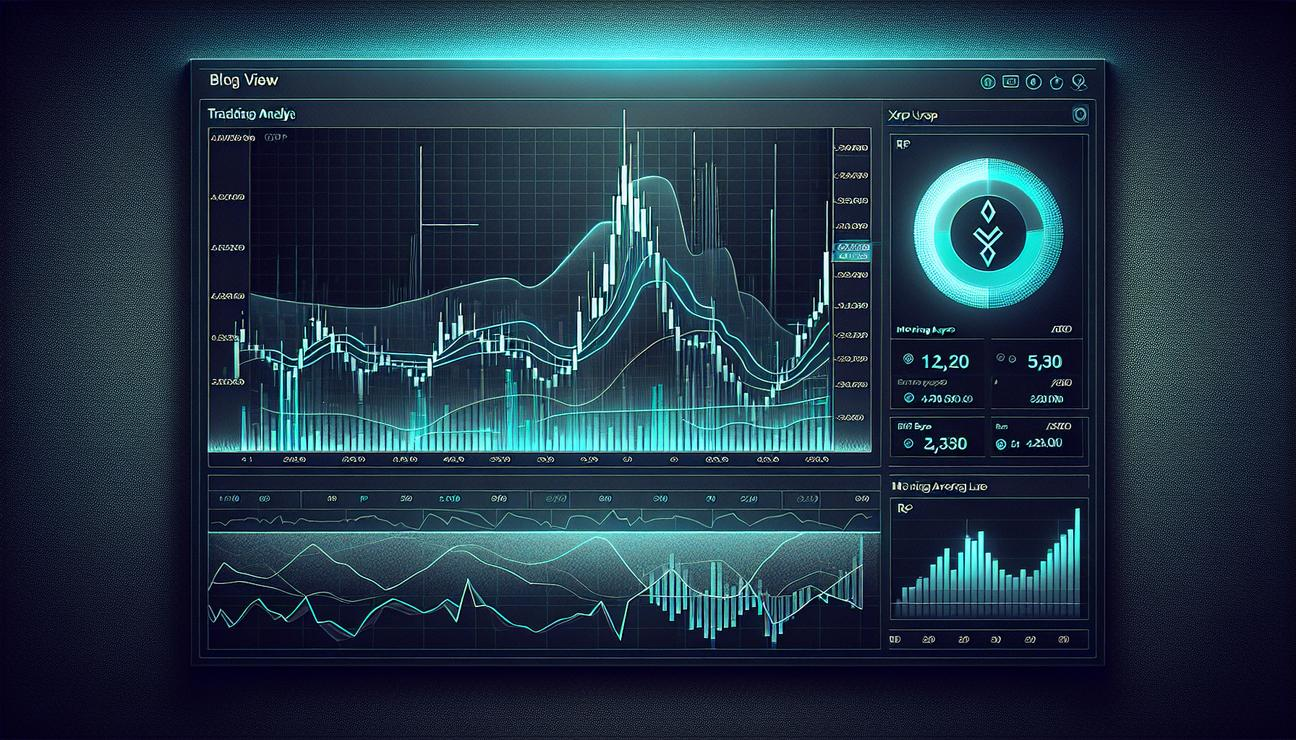
Summary of the Market View
XRP is facing ongoing selling pressure in two important markets: against the stablecoin Tether (USDT) and against Bitcoin (BTC). The price is making lower highs and lower lows, which is a sign of a downtrend. Despite a few small bounces from support levels, the bigger trend still favors sellers. The price is below key indicators that traders watch, such as moving averages, and it is moving inside a downward or falling pattern. This means there is a higher chance of more declines rather than big rallies in the near term.
For readers new to some terms here, XRP is the digital currency used on the XRP Ledger platform. The XRP Ledger is a payment system started in 2012 by a company called Ripple Labs. The system uses XRP as its native currency. In this article, you will also see references to Tether (USDT), a type of cryptocurrency called a stablecoin that is tied to the U.S. dollar, and to Bitcoin, the first decentralized cryptocurrency. To help you understand the trading signals, we will also explain the RSI and moving averages in simple terms as we go along.
Ripple Price Analysis: The USDT Pair
On the XRP/USDT chart, XRP is moving inside a clearly defined downward path. This is often called a descending channel. In this pattern, prices bounce between two downward sloping lines. The price repeatedly hits, or gets rejected by, the middle line (the midline), the upper line (the upper trendline), and important moving averages. A moving average is a tool that smooths out price data to show the general direction. In simple words, it is like looking at the average price over a period to see where the price trend is headed.
Recently, XRP rose a bit from a demand area around $1.20. A demand zone is a price area where buyers usually step in. However, this bounce failed to push the price back above a higher area around $1.80. That is a sign that the rise was not strong enough to reverse the trend. In trading language, the rally was still a correction within a larger down move, not a true change in direction.
The momentum behind the move down is also visible in the RSI, a tool that helps traders see if the price has become overbought or oversold. RSI readings below 50 generally indicate weaker buying power. In this XRP/USDT pair, the RSI stays below 50, which means there is not enough bullish (upward) momentum to push prices much higher right now.
For traders watching the key levels, the main picture remains clear: as long as XRP stays below the mid-channel resistance and below the big moving averages, the path of least resistance is toward still lower prices. The two big moving averages to watch are the 100-day and the 200-day averages, which sit near $1.90 and $2.30 respectively. If the price breaks above these moving averages, it could be a sign that selling pressure is easing. But until then, the downside risk stays elevated, with the important level of $1.20 acting as a critical floor where buyers could try to defend the price.
To help connect the dots, here are quick explanations of the key ideas in plain language:
– Descending channel: a downward path with two lines that contain price action. Think of it as a downward slide that price often touches but doesn’t break for long.
– Moving averages: a simple way to spot the general direction of price by averaging past prices. If the price stays below these lines, it suggests the downtrend is still in control.
– RSI (Relative Strength Index): a gauge that helps traders see if prices are too high or too low. A value below 50 generally indicates weaker buying power. A value above 50 would suggest more bullish strength, at least for a time.
For readers who want a quick reference, RSI and moving averages are common tools used by traders to judge momentum and trend direction. You can think of them like weather forecasts for prices: they help you see the likely direction of price movement over a period of time.
Ripple Price Analysis: The BTC Pair
Looking at XRP versus Bitcoin, the picture is similar in terms of weakness. XRP is trading below both the 100-day and 200-day moving averages in this pair as well. In practice, that means XRP is under pressure even when compared to Bitcoin, a much broader benchmark in the crypto space. The moving averages here are located above the 2,200 sats area. A «sats» or satoshi is the smallest unit of Bitcoin, like cents in a dollar. One Bitcoin equals 100,000,000 sats. So when traders talk about 2,200 sats or 2,000 sats, they are referring to small Bitcoin price levels expressed in sats.
Prior gains from a recent breakout did not hold. There was a rejection around the 2,200 to 2,400 sats zone, which suggests sellers are defending higher prices and pushing the market back down. The price then compresses near a key horizontal support around 2,000 sats. This area acts like a floor where buyers might step in again to slow or stop further declines.
The momentum profile on the XRP/BTC pair is described as neutral-to-bearish. The RSI staying below 50 means the buyers’ power to lift XRP against BTC remains limited. If XRP were to slip below the 2,000 sats support, there could be more downside relative to Bitcoin. On the other hand, if XRP can reclaim the moving average cluster around the 100-day and 200-day lines, it would be the first sign of potential strength versus Bitcoin. Such a move could show that XRP is starting to win back some ground against BTC, even if the broader market remains cautious.
In simple terms, the XRP/BTC chart is telling traders: the current trend is not friendly to XRP. A break below the 2,000 sats level would add to the downside risk, while a return above the moving averages could begin to change sentiment, at least in the short term.
What This Means for Traders and Investors
For people who trade XRP or invest in it for the longer term, these charts are a warning that the immediate horizon is not favorable. A few quick takeaways can help readers think about what might come next:
- The price remains stuck in a downtrend on both USDT and BTC pairs. This makes new buying less attractive unless a clear change in momentum appears.
- Key price zones to watch on the USDT pair are $1.20 (support) and $1.80–$2.00 (initial resistance area). If the price can break above the 100-day and 200-day moving averages near $1.90 and $2.30, a different dynamic could emerge, but that would require stronger buying power.
- On the BTC pair, watch the 2,000 sats level as a crucial support. A move below this could lead to more underperformance versus Bitcoin, while a move back above the moving averages would be a positive sign for XRP against BTC.
- RSI readings below 50 suggest that the market still lacks robust bullish momentum. A sustained move above 50 could help fuel a rebound, but only if accompanied by price action and volume that confirm the change.
Remember that markets can change quickly. Traders should combine chart signals with other information, such as news about the crypto market, overall market trends, and personal risk tolerance. It is always a good idea to not risk more than you can afford to lose and to think about using risk controls like stop-loss orders when trading volatile assets like XRP.
Glossary of Terms for Quick Understanding
Below are simple explanations of the main terms mentioned above. If you want more detail, you can click the links to see the official Wikipedia explanations.
- XRP Ledger — The XRP Ledger (XRPL), also called the Ripple Protocol, is a cryptocurrency platform launched in 2012 by Ripple Labs. It uses the native currency XRP and supports tokens and other units of value. For a detailed description, see XRP Ledger.
- Tether (cryptocurrency) — Tether, often referred to by its currency codes USD₮ and USDT, is a cryptocurrency stablecoin pegged to the United States dollar. For more, see Tether (cryptocurrency).
- Bitcoin — Bitcoin is the first decentralized cryptocurrency. For background, see Bitcoin.
- Relative Strength Index — The relative strength index (RSI) is a technical indicator used to measure the magnitude of recent price changes to evaluate overbought or oversold conditions. See Relative Strength Index.
- Moving average — A moving average is a calculation that analyzes data by creating a series of averages of different subsets of the full data set; in finance it smooths price data to identify trends. See Moving average.
The analysis above reflects ongoing market conditions as reported by market watchers. Traders should stay informed and consider multiple viewpoints before making decisions. As markets evolve, new patterns can emerge that change the current outlook.
Disclaimer: The information provided here is for educational and informational purposes only. It does not constitute financial advice or a recommendation to buy or sell any asset. Always do your own research and consider consulting a licensed financial advisor before making investment decisions.
Source note: The insights summarized above are drawn from market charts and price action for XRP in relation to USDT and BTC markets.